Government minister Stephen Morgan has learned how Southampton researchers are improving children’s long-term health prospects.
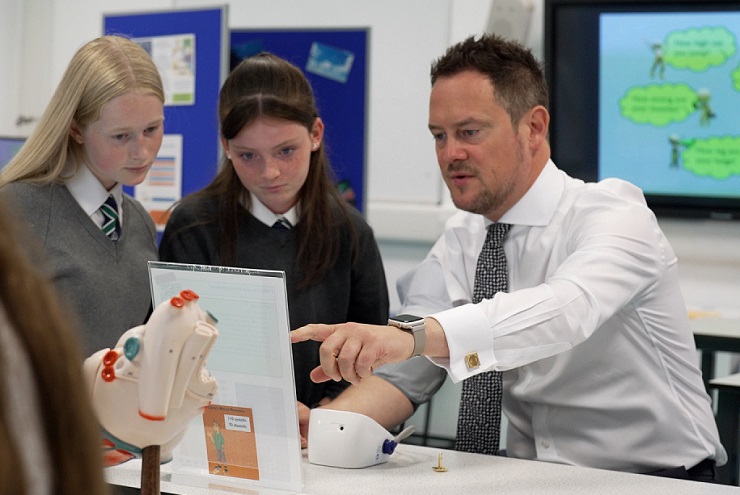
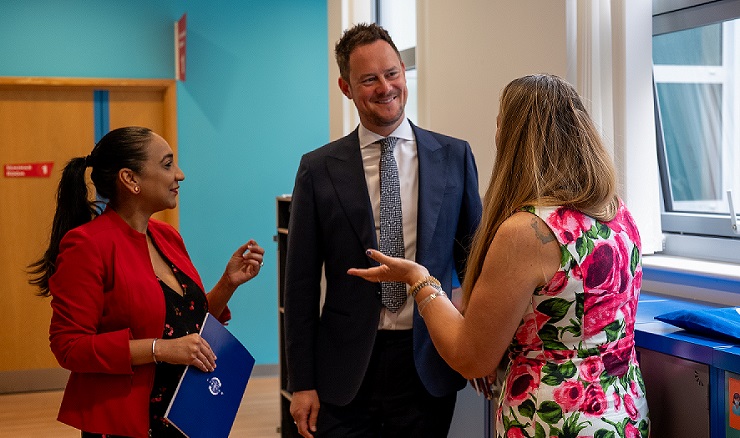
The Minister for Early Education and visited University Hospital Southampton (UHS) yesterday. He was joined by the Member of Parliament (MP) for Southampton Test, Satvir Kaur. They spoke to pupils from a secondary school in Gosport, who were taking part in a hands-on session at LifeLab.
LifeLab is a unique research-based educational programme. It is a collaboration between the University of Southampton, the NIHR Southampton Biomedical Research Centre and UHS. Its teaching laboratory is based at Southampton General Hospital. The programme empowers children and young people to understand the science behind their health. This informs the choices they make for their own lives.
Official engagement
Stephen Morgan oversees early education in his ministerial role. He has a particular interest in the use of data, digital technology and science.
During his visit to LifeLab, the Minister mixed with secondary school students from King’s Academy Bay House School. They explored how factors such as diet, physical activity and sleep can affect their health and wellbeing.
He also heard how scientists are using big data on pregnancy and early life to predict obesity at a young age.
“It’s been brilliant to see the impact of the innovative work to improve child health being driven by the university.”
“Through our Plan for Change this government is determined to give every child the best start in life, which includes creating the healthiest generation of children in our history.”
“As we roll out free breakfast clubs across the country and make free school meals available to all households on universal credit, we will continue working alongside experts and the sector to build a healthier future for generations to come.”
Long-lasting benefits
The LifeLab programme is linked to the school curriculum. Over the last twelve years, it has worked with more than 17,000 secondary school students from over 120 schools.
The programme is also reaching primary school children across the city through Early LifeLab. It is up and running in over 40 percent of Southampton primary schools. To date, it has reached more than 6,500 children.
“We were delighted to welcome Mr Morgan to LifeLab to see first-hand the interactive way we engage young people with the science behind the health messages. This gives them the skills and knowledge to be able to make healthier choices.”
– Kath Woods-Townsend
“We believe that supporting young people to lead healthier lives will not only positively impact them now, but also their future selves and their future children.”
– Kath Woods-Townsend
“It was good to see the students show Mr Morgan the ways the programme has helped them reflect on how they can make informed decisions about their own lives.”
– Kath Woods-Townsend
Obesity Research
The MPs also met the University of Southampton’s Professor Nisreen Alwan, Professor Simon Fraser and Dr Nida Ziauddeen. They are leading a study that aims to identify whether a child is at risk of obesity in later life. It is using data collected during pregnancy and early childhood at UHS.
The researchers have devised a prediction model to estimate the risk of obesity at primary school. It will help provide targeted interventions. This could support families, nurseries and schools to mitigate the risk of children becoming overweight.
They have also found lower education and academic ability in primary school is related to greater use of health services, with more hospital admissions and outpatient appointments, when they reach middle age. The age at which people leave school seems to be an important mediator in this relationship, underscoring the positive impact of time spent in education.
This research was supported by NIHR Applied Research Collaboration Wessex and the NIHR Southampton Biomedical Research Centre.
“Obesity increases our risk of developing other long-term health conditions later in life.”
– Professor Nisreen Alwan
“It’s important to develop tools to help us identify families at risk early on in children’s lives and provide support and resources to them. Preventing obesity across generations is key to improving the population’s health.”
– Professor Nisreen Alwan