Students interested in studying Medicine came to Southampton from across the country for a course designed to prepare them for applying to university.
Widening Access to Medicine is intended for Year 12 students who plan to apply through a widening participation programme or contextual admissions route. It equips them with valuable knowledge and skills to support their application. The event took place in April at the University of Southampton’s (UoS) Highfield Campus. It also included virtual work experience with staff at University Hospital Southampton (UHS).
Kate Bartlett, Developing Talent Lead at LifeLab, delivered the programme. LifeLab is a joint initiative between UoS, UHS and the NIHR Southampton Biomedical Research Centre. It aims to empower children and young people, through science, to make positive lifestyle choices.
Supporting applicants and enhancing equity
Ensuring that all young people have the appropriate opportunities and support to apply for medical school will enrich our learning environment and the profession. Currently, one third of schools do not produce any medical school applicants, and outreach activities from medical schools can support those communities who are currently underrepresented in medical school admissions.
The University of Southampton offers both contextual admissions and a specific widening participation medical degree aimed at specific under-represented groups. There are also scholarships, grants and bursaries which can provide additional financial support for these students throughout their degree.
Widening Access to Medicine is a three-day hybrid course. This includes one in-person day at Highfield Campus, online workshops, and one day of live virtual work experience with UHS staff.
Overall, 28 students visited Highfield Campus for the event. To be eligible to attend, they needed to be studying A Level Biology and one additional science, and to meet certain criteria aligned with those of the University of Southampton’s widening participation medical degree.
These included living in a disadvantaged area, being a young carer, being looked after by a Local Authority, or being part of a travelling family. They might have received free school meals in secondary school, they or their parents or guardian could be receiving benefits, or they may be the first generation in their family to apply to Higher Education.
In this way, the Widening Access to Medicine course provides young people who may not have had access to the same opportunities or support as others with valuable information, skills and experience to support their application for Medicine.
“We had a brilliant bunch of students work with us for those three days”.
– Kate Bartlett
“They were so passionate and engaging, and it was wonderful to see the new cohort of medical school applicants. Our medical student ambassadors worked so hard, inspiring the next generation. It’s a great project to be a part of!”
– Kate Bartlett
An enjoyable and valuable experience
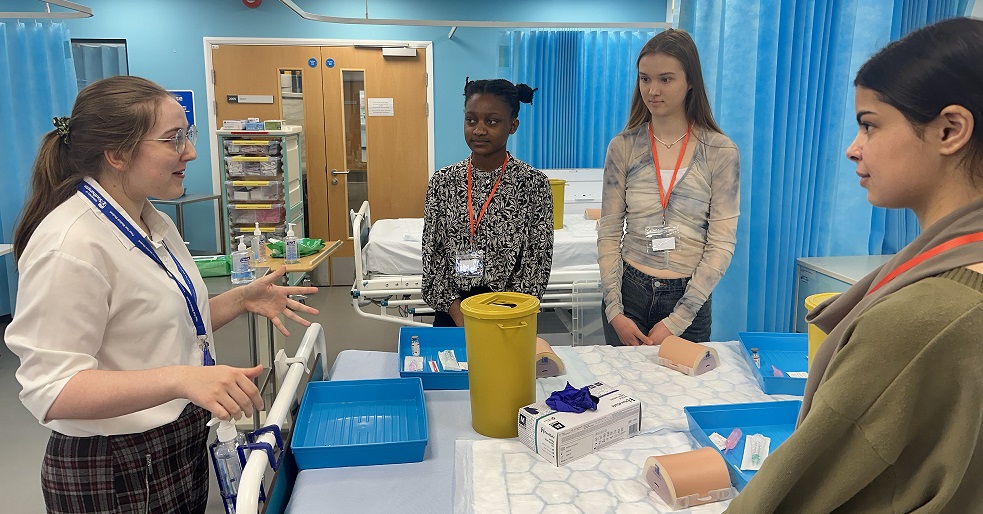
Students who attended had the chance to practice their clinical skills, do mini-interviews, and talk to medical students and staff. They explored medical specialities, discussed medical ethics, and saw live clinics as part of their virtual work experience.
Dr Anoir Lagzouli gave a keynote speech, while Dr Shmma Quraishe spoke about the University Clinical Aptitude Test (UCAT) and admissions process.
“While a strong academic foundation is essential, medicine is not just about academic prowess. It is also about the personal qualities that enable future doctors to thrive in a demanding profession.”
– Dr Quraishe
“Our admissions process looks beyond grades. It aims to identify applicants who interact and communicate well with others, are self-motivated, resilient and have reflected on and learnt from life experiences. We look for them to demonstrate growth, maturity, and a genuine commitment to patient care.”
– Dr Quraishe
As part of the University’s new initiative ‘Study Local, Stay Local’, it offers some interview places on the BM6 programme for local applicants, whose address is in Dorset, Hampshire and Wiltshire. They also have places for graduates from the University of Southampton who apply to the BM4 programme. Applicants must meet both the non-academic and academic criteria for these programmes to be eligible.
The students who took part have said they found the experience useful, and that they plan to use the knowledge and skills they have gained in their university applications.
“Valuable experience, and will definitely be drawing upon these learning experiences in my interviews and personal statement. The course was well-rounded, and I loved it. Thank you very much.”
– Ava Bridger
“I really enjoyed coming to Southampton and exploring the medicine course at the university. I was able to meet other participants and student ambassadors, as well as some staff members. I was able to see how welcoming and friendly the university and the town itself is.”
– Maryam Al Marjan
“I would just like to reiterate how grateful I am for everyone who helped with this event, as it really helped me. It was extremely useful, and had all the information needed for somebody who is interested in studying medicine at university.”
– Aylin Ghanavatzadeh